Press & Publications
Dear healthcare Community: Women’s Health and Psychedelic Medicine Can’t Wait
To care for women is not only to work within what is known, but to stay in relationship with what is unfolding.
We are in a moment of flux, and women are no longer waiting. They are taking their health into their own hands, reading their own labs, and asking harder questions. They are paying top dollar for therapies their primary care will not offer and their insurance plans won’t cover. They are expecting more from their providers, their medicines, and the system itself.
They are also taking psychedelics.
You'll Probably Be Back: What MDD and TRD Patients Should Really Expect from Psychedelic Therapy and How Care Providers Should Be Talking About It
There's a particular kind of hope that arrives with a first ketamine infusion, or a first psilocybin session. For many people living with Major Depressive Disorder (MDD) or Treatment-Resistant Depression (TRD), it's the first time in years, sometimes ever, that the weight has lifted.
But there's a conversation that doesn't always follow that moment — one that clinicians might not be having, that medical staff don't always know how to approach, and that marketing materials rarely want to touch. It's the conversation about what happens next. When asked directly, clinical staff will be transparent, for the most part. They’ll explain that the therapeutic journey is lifelong, and that psychedelic-assisted therapy is not a magic bullet, nor a promised cure.

Afrofuturism Is a Psychedelic Practice—Even Without the Drugs
There is a tendency to pair psychedelia with something ingested, like a molecule, and perhaps a mind melting experience.
But long before the current psychedelic renaissance found its language in clinical trials and venture capital, there were entire cultural movements that embodied psychedelic thinking without relying on substances at all. Afrofuturism is one of them.
Afrofuturism is often described as a cultural aesthetic that blends science fiction, African diasporic history, and speculative futures. Afrofuturism is also very much a reorientation of perception. It dissolves linear time, reclaims narrative authorship, and constructs alternate realities in which Black identity is expansive, technologically integrated, and cosmically situated. In other words, it does what psychedelics are often said to do: it loosens the grip of inherited structures and opens the door to new ways of seeing.
Techno & The Neuroendo
In 1998, a team of Italian researchers led by G. Gerra published a study in the International Journal of Psychophysiology that would become one of the most cited pieces of evidence that electronic music does something measurable to the human body's internal chemistry. Their paper, "Neuroendocrine responses of healthy volunteers to 'techno-music': relationships with personality traits and emotional state," set out to do something deceptively simple: draw blood from young people before and after listening to techno, and see what changed. What they found was remarkable. The beat was rewriting hormones.
This is a story about that study, about what the neuroendocrine system is and why it matters, about the new science of psychedelic medicine that is using these same biological levers as targets for healing, and about the strange, beautiful convergence of electronic music, chemistry, and consciousness research unfolding right now.
Psychedelics for Help with Addiction and Substance Use Disorder
Psychedelics may serve as a potential treatment for addiction, offering a novel approach that targets the emotional, psychological, and neurochemical roots of substance use disorders. Substances like psilocybin and LSD, for example, are believed to disrupt habitual thought patterns and promote introspection, facilitating emotional healing. While ibogaine, the psychoactive alkaloid derived from the iboga plant, can also foster deep insight, it is also believed to help with addiction by modulating the brain’s dopaminergic and opioid systems, reducing withdrawal symptoms and cravings.

Why Psychedelic-Assisted Therapies for Women’s Health Transitions
Women’s mental health is not static. Across the lifespan, key transitions like the postpartum period, the premenstrual window, and midlife are marked by profound biological shifts alongside equally profound changes in identity, meaning, and self-relationship. Yet these transitions are often treated as isolated mood disorders, divorced from the hormonal, neurological, and existential contexts in which they arise.
Psychedelic-assisted therapies offer a different lens. One that recognizes women’s health transitions as whole-system events, involving brain chemistry, nervous system regulation, emotional processing, and identity reorganization all at once.
The New Wave of Nervous System Regulation: Between Science, Spirituality, and Silicon Valley
There's a peculiar moment happening in wellness right now. On one hand, we have NASA-grade biofeedback devices and FDA-approved digital therapeutics. On the other, we have people lying on vibrating beds claiming to access "non-ordinary states of consciousness." And, both might be onto something.

An Interview by Sara Payan
In Fat Nugs Magazine’s Psychedelics Edition, clinical neuropharmacologist Stephanie Karzon Abrams sits down with Sara Payan, host of Planted with Sara Payan, for a candid conversation on her journey from ICU medicine to psychedelic therapy, plant medicine research, and advocacy. As founder of Beyond Consulting, Stephanie shares how her integrative approach to strategy, clinical operations, and scientific advisory is shaping the future of psychedelic medicine. The discussion explores building relationships and rituals with plant medicine, as well as how to engage with psychedelics safely and intentionally. Stephanie also highlights the role of joy in healing, sharing insights from her new project, The Chemistry of Joy, co‑created with Jane Garnett, LMFT—reminding us that joy is not something to earn, but something to cultivate.
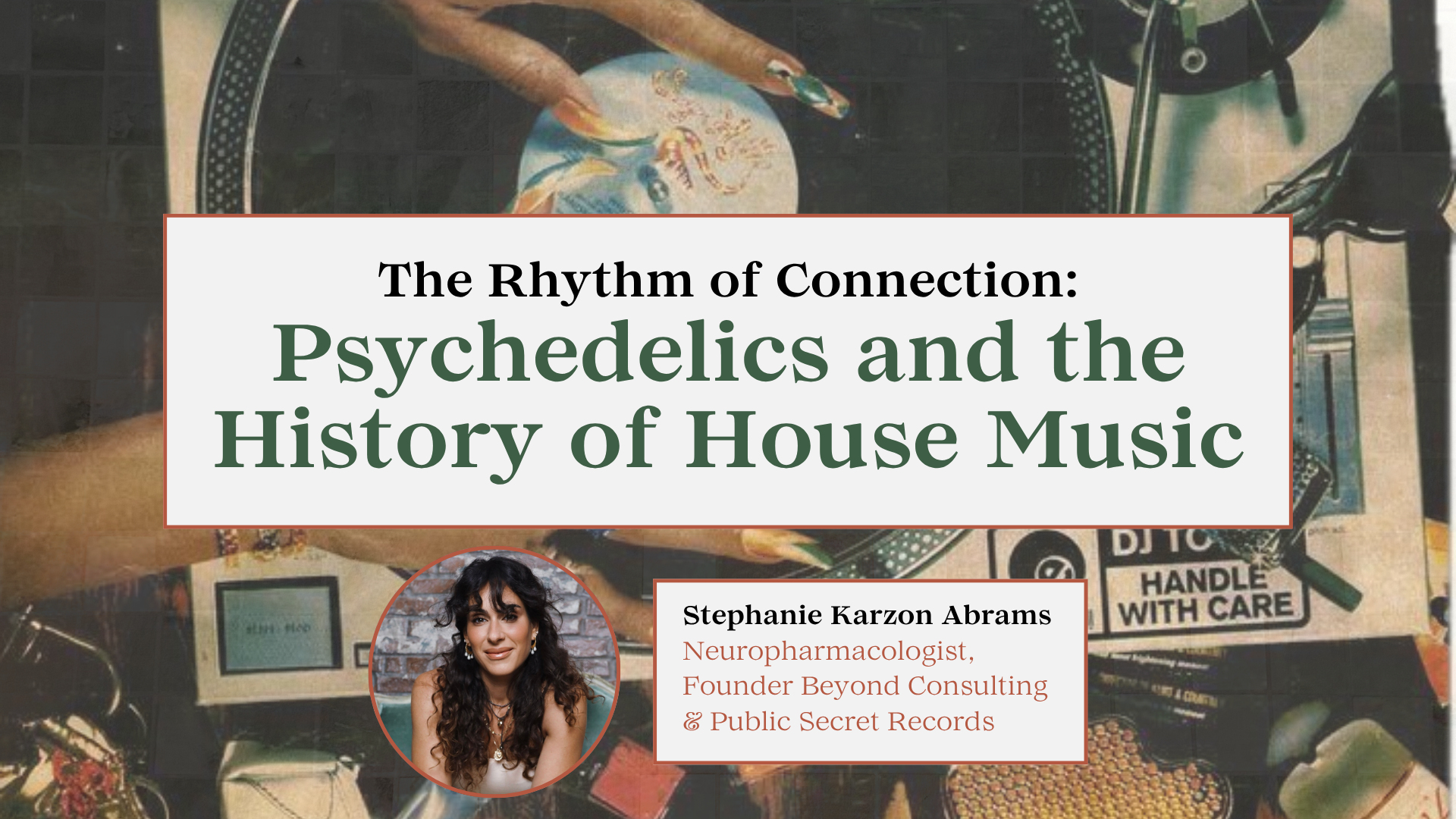
MAPS PS 25 The Rhythms of Connection: Psychedelics & The History of House Music
This story begins with rhythm—sacred, communal, embodied. The story of house music didn’t start in a nightclub, it started around a fire.

Mental Health Crises in the ER and A New Opportunity for Ketamine
Can Ketamine Change Crisis Care?
Emergency Rooms (ERs) often serve as the frontline for patients, where life-threatening trauma and routine injuries collide in chaos. They’re also where countless individuals experiencing mental health crises end up when there’s nowhere else to turn.

Honeysuckle Mag
According to Abrams and Mignot, the project originated from semi-underground nomadic bliss: “We once threw a secret party on a beach called ‘Public’ on the island of St. Barts. We were inspired by our humble beginnings to create ‘Secret Sessions,’ where the locations are revealed only a few hours before the event begins. We now travel the world, driven by a passion for bringing people together, bringing you a sonic atlas of rhythms encountered globally.”

Medium
Boosts mental clarity and emotional resilience.
Taking time for self-care — whether through mindfulness, journaling, or simply stepping back from the chaos — allows us to process our emotions and thoughts more effectively. When we prioritize our mental well-being, we’re better equipped to handle stress, make clearer decisions, and navigate challenges with greater emotional resilience.

Canvas Rebel
Before long, I realized I was doing exactly what I had set out to do — just not through a job I had applied for, but through a business I built. That’s how Beyond Consulting was born — a firm designed to support visionary organizations in psychedelics, plant medicine, and wellness with research, strategy, and operational solutions.

Set. Setting. Sound.
This interplay of experimentation, openness, and intention underscores the profound synergy between music and altered states of consciousness, creating not just entertainment, but deeply transformative experiences.

New York Magazine The Strategist
While kanna is a psychoactive, it’s not psychedelic, so you won’t experience hallucinations. And it’s not neurotoxic, which Stephanie Karzon Abrams, a neuropharmacologist and the founder of Beyond Consulting (a group that provides research to organizations and clinics working with plant medicines), says is huge. “If you take a big dose, the most that could probably happen to you is that you’ll feel nauseous, you’ll probably get a headache,” Abrams says. Kanna has been known to induce a nauseated or a tingly feeling in the stomach, even in small amounts, because “of the serotonin signaling in both gut and brain", she explains. For some, this can also induce an appetite-suppressing effect. And taking kanna if you’re already on prescription SSRIs is generally considered a no-no. “That’s a lot of serotonin flowing through your body, and that can be a lot to handle,” says Abrams.


Nutrition Business Journal
Magic moment: The growing market for microdosing psilocybin—still classified as a Schedule 1 substance—raises safety and quality concerns.
Stephanie Karzon Abrams, research and science advisor for the Microdosing Collective, a California-based nonprofit, working to advance and protect the right to microdose, advocates for a regulatory model granting “independence and sover-eignty around microdosing.” While safety measures may be needed because “it’s a medicinal plant and not without risk,” she emphasizes education is key. “Years and years ago, people traditionally communed with these plants, and there were medicine keepers, or shamans. At a very young age, kids were taught about the power and the reverence and respect this medicine is owed,” Karzon Abrams says. “That’s not our norm, and people are approaching higher doses without education and without preparation, so the risk is tenfold.”

Gastronomy Mag
The boundaries between science and creativity, healing and expression, often feel impenetrable—until you meet someone who bridges them seamlessly. Stephanie Karzon Abrams is that person. Her journey from Montreal’s ICU wards to the forefront of psychedelics and creativity isn’t just a career trajectory; it’s a testament to what happens when curiosity and courage intersect.